
Texas Criminal Court Records
Texas criminal court records are public documents kept at the courthouse in the county where the case was filed. You can search them online through the statewide re:SearchTX portal or through county-level search systems. The Texas Department of Public Safety also runs a conviction database that lets you search criminal history by name. For felony cases, records are at the District Clerk's office. For misdemeanors, they are at the County Clerk's office. This guide covers where to find criminal court records in Texas, how to search them, and what each type of record contains.
Texas Criminal Court Records Overview
How to Search Texas Criminal Court Records
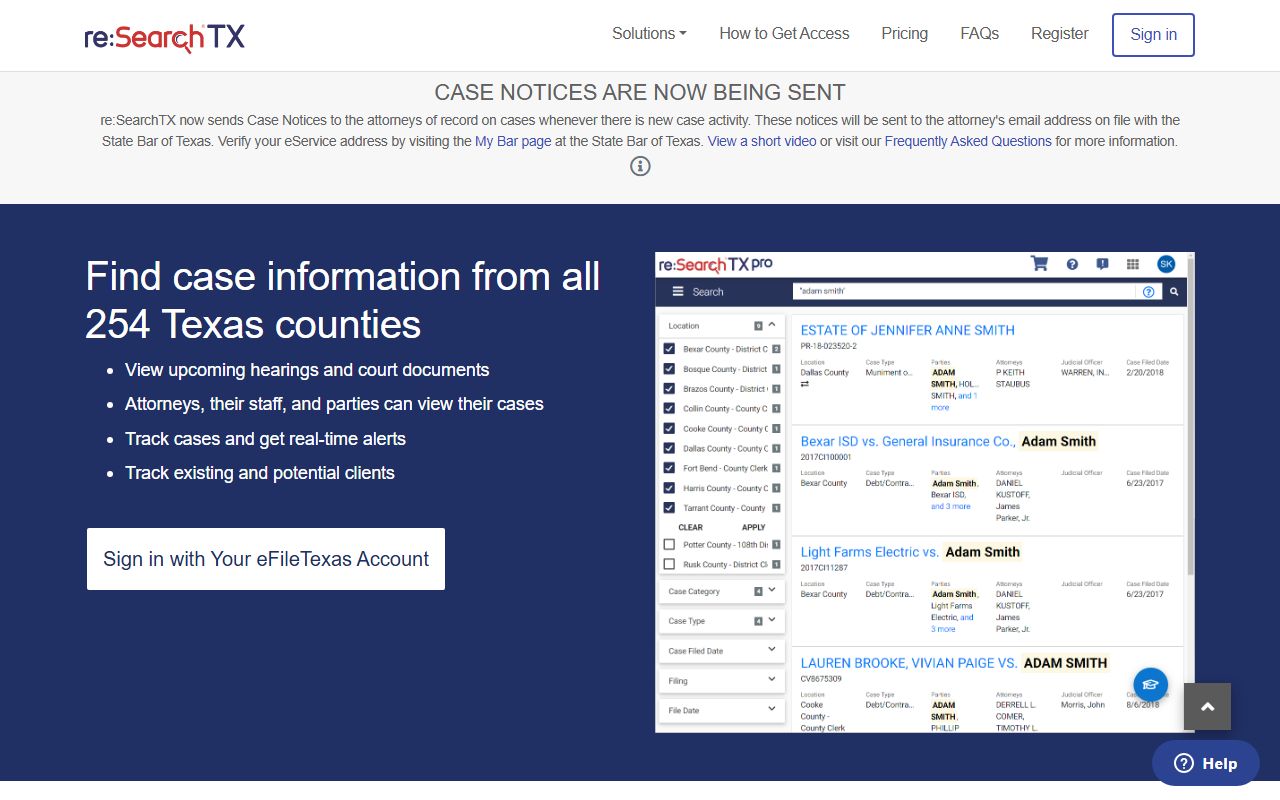
Texas gives you several ways to look up criminal court records. The statewide re:SearchTX portal is free and covers District Courts in many of the state's 254 counties. You can search by party name, case number, or attorney name. The system shows case status, party information, charges, and court dates. It does not cover every county yet, but the list keeps growing. For counties not on re:SearchTX, you go directly to that county's District Clerk or County Clerk.
The Texas DPS Criminal History Name Search is a second option. It searches the Conviction Database, which holds public conviction and deferred adjudication records for Class B misdemeanors and above. You must create an account on the DPS public site to use it. Searches cost $3.00 each with additional processing fees based on payment method. The database is updated regularly with information from courts and law enforcement across Texas. If a record is missing or incorrect, you can call (512) 424-7256 for help.
A third route is the fingerprint-based background check through the Fingerprint Applicant Services of Texas (FAST). This is the most accurate method because it matches on biometric data rather than name alone. The fingerprint scan fee is $10.00, and the criminal history record check costs $15.00. FAST locations are throughout the state and require an appointment. Call (888) 467-2080 or schedule online through the DPS website at dps.texas.gov.
To search in person, visit the courthouse in the county where the case was filed. The District Clerk handles felony cases. The County Clerk handles misdemeanors. Staff can pull records by name or case number and make copies.
Texas DPS Crime Records Division
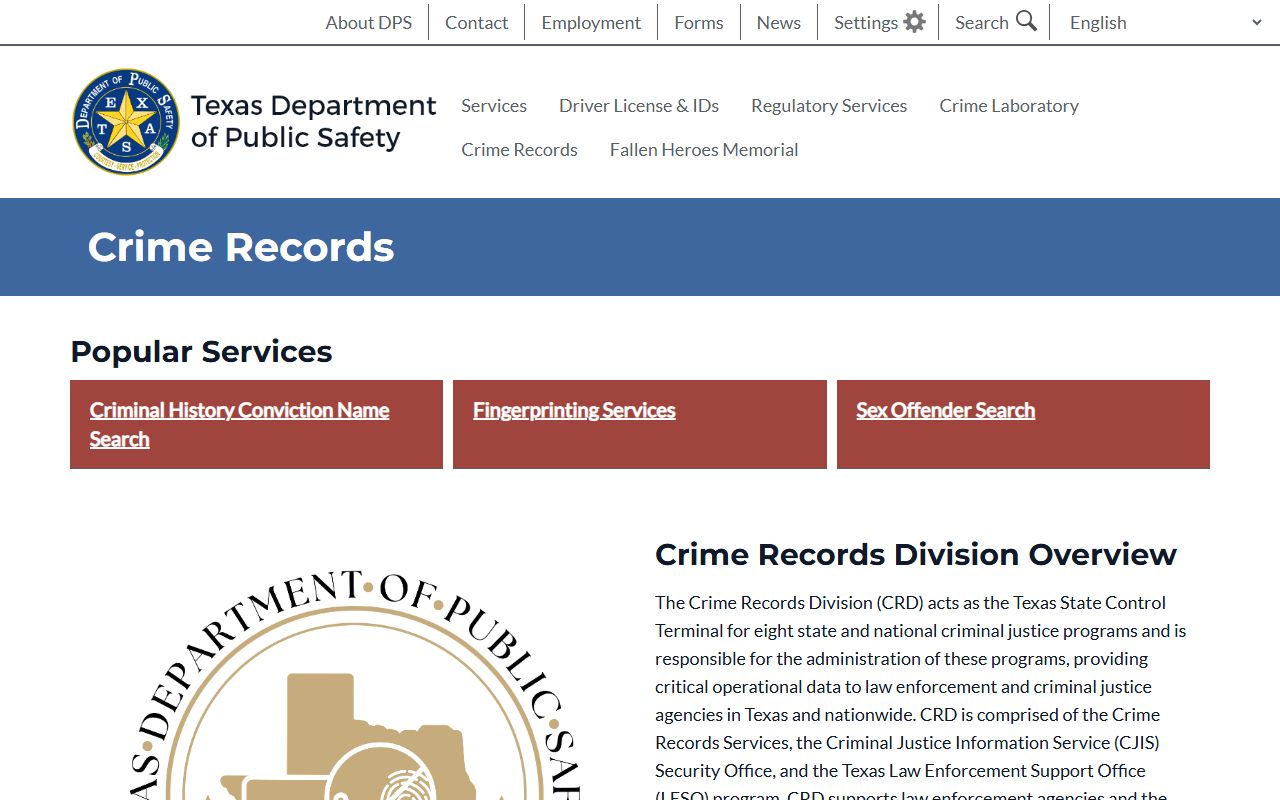
The Texas Department of Public Safety Crime Records Division is the state's central hub for criminal justice information. It acts as the Texas State Control Terminal for eight state and national criminal justice programs. The Division collects information submitted by local criminal justice agencies across Texas, compiles it into statewide databases, and forwards it to federal databases at the FBI.
The Crime Records Division manages the Computerized Criminal History (CCH) system. This system holds biometric identification data, arrest records, conviction records, and deferred adjudication information. Only convictions and deferred adjudications for Class B misdemeanors and above are public. Arrests without charges or acquittals are not public through the name search system. The Division also oversees the Criminal Justice Information Service Security Office and the Texas Law Enforcement Support Office.
Contact the Crime Records Division at:
- Texas Department of Public Safety, Crime Records Service
- P.O. Box 4143, Austin, TX 78765
- Phone: (512) 424-2000
Note: The DPS public name search only shows records that are public. If you believe a record should be in the system but isn't showing, call (512) 424-7256.
re:SearchTX - Statewide Court Records Portal
The Texas Judicial Branch launched re:SearchTX as the official public portal for court case information. It provides access to case index information and documents from eFiling-integrated courts across the state. The Texas Supreme Court and the Court of Criminal Appeals issued orders requiring all state District Clerks and County Clerks to connect their case management systems to re:SearchTX. Larger counties were required to integrate first, and smaller counties are still coming online.
Through re:SearchTX you can view case details, upcoming hearings, and filed documents for integrated courts. Attorneys and staff can track their own cases. Parties can monitor case progress. Search by case number, party name, attorney name, or court. The clerk of the court is the official custodian of records. Re:SearchTX provides an unofficial copy for reference. For a certified copy or official record, contact the clerk directly.
What Texas Criminal Court Records Contain
A Texas criminal court case file includes documents from every stage of the case. The file starts with the complaint or arrest affidavit, then the formal charging instrument. For felonies, that is an indictment from the grand jury or an information filed by the DA. For misdemeanors, the DA files an information directly. The file then grows with every motion, hearing, order, and judgment added along the way.
Key documents in a Texas criminal case file include:
- Arrest warrant or complaint
- Indictment or information stating the charges
- Bond documents and conditions of release
- Docket entries for each court appearance
- Motions filed by the defense and prosecution
- Plea agreements
- Judgment of conviction and sentence
The defendant information section of the case file includes full legal name, date of birth, aliases, physical description, State Identification Number (SID), and last known address. Charges are listed with the specific Texas Penal Code section, offense level, and offense date. Bond records show the bond type, amount, and bonding company. Sentencing records detail whether the defendant received incarceration, probation, a fine, or a combination. If probation was revoked, those records are in the file as well.
Most of this is public. Social Security numbers and some financial information may be redacted. Juvenile records are not public. Sealed cases require a court order to view.
Texas Criminal Court System
Texas has two levels of criminal courts. District Courts handle felony cases. County Courts handle Class A and B misdemeanors. Justice of the Peace courts and Municipal Courts handle Class C misdemeanors, which include traffic offenses and minor violations. Each court level keeps its own records and has its own clerk.
The Texas Court of Criminal Appeals is the court of last resort for all criminal matters in the state. It has final appellate jurisdiction over criminal cases ranging from theft to capital murder. The Court has nine judges elected to six-year terms. It has exclusive jurisdiction over automatic appeals in death penalty cases. For all other criminal appeals, the case first goes to a Court of Appeals, which can then be reviewed by the Court of Criminal Appeals on a petition for discretionary review.
The Office of Court Administration supports the Texas judiciary with technology, statistics, and policy guidance. The OCA manages the CourTex Case Management System used by smaller counties, collects annual statistical reports on caseloads and clearance rates, and coordinates with the Supreme Court on rules amendments. They also publish guidance on public access to court records.

Public Access to Texas Criminal Court Records
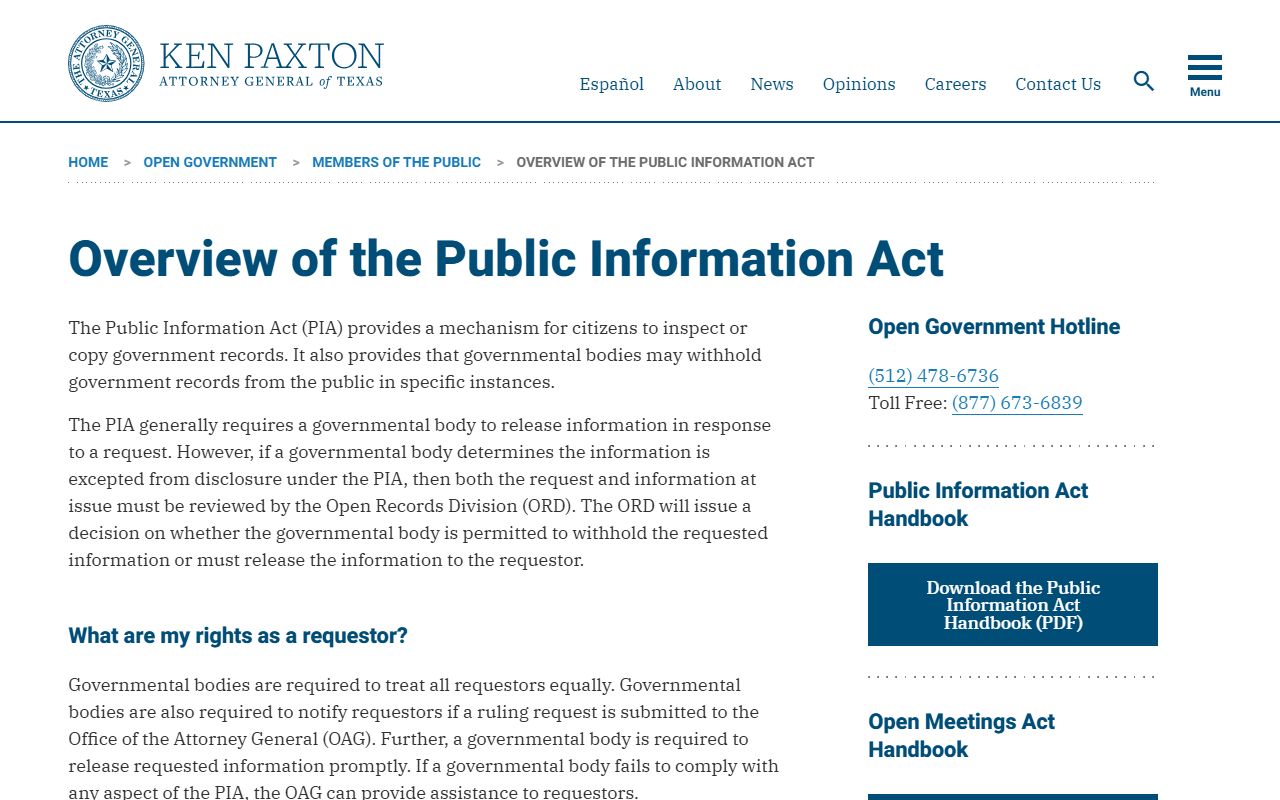
Criminal court records in Texas are generally public under Texas Government Code Chapter 552, also known as the Public Information Act. Under Section 552.021, government records are public if they were created, collected, or maintained in connection with official business. Court records fall under this definition. Access to judicial records is also governed by the Rules of Judicial Administration adopted by the Texas Supreme Court and Court of Criminal Appeals.
The Texas Attorney General's Open Government Division oversees compliance with the Public Information Act. If a government body refuses to release records, you can request a ruling from the Attorney General's Open Records Division. The governmental body must promptly produce public information. If it will take longer than ten business days, they must notify you of when the records will be ready.
Section 552.108 provides exceptions for law enforcement records when release would interfere with an active investigation. However, basic information about an arrest must still be released. That includes the name, age, address, charge, and circumstances of arrest. Texas Government Code Chapter 411, Subchapter F separately addresses criminal history record information held by DPS, which is generally not public and may only be released as authorized by law.
Texas Department of Criminal Justice - Offender Records
The Texas Department of Criminal Justice handles the custody of people sentenced to Texas state prisons. The TDCJ maintains records on each offender, including intake information, classification, disciplinary history, and release data. The agency's Correctional Institutions Division manages records at PO Box 99, Huntsville, TX 77342-0099, phone (936) 437-6231.
TDCJ provides a free online offender search tool. You can search by full name, TDCJ number, or SID number. Results show the offender's current facility, offense, sentence length, and projected release date. The agency also runs a victim notification program that alerts registered victims when an offender's status changes.
The Parole Division maintains records on offenders released on parole or mandatory supervision. The Community Justice Assistance Division oversees community supervision, which is the Texas term for probation. Probation records are kept by the local community supervision and corrections department in each county.

Expunction of Texas Criminal Records
Chapter 55 of the Texas Code of Criminal Procedure governs the expunction of criminal records. A person may petition for expunction if they were arrested but not charged, if charges were dismissed, if they were acquitted at trial, or if they were convicted but later found to be innocent. Expunction removes the record from public access and requires all agencies to return or destroy their copies.
Waiting periods apply before a person can file for expunction. For Class C misdemeanors, you must wait at least 180 days from the arrest date. For Class A and B misdemeanors, the wait is at least one year. For felonies, you must wait at least three years. The waiting period may be waived if the state's attorney certifies that the records are not needed for any ongoing investigation.
To file for expunction, you petition the district court in the county where the arrest took place. The petition must include your full name, date of birth, driver's license number, Social Security number, and details about the arrest. You serve notice on the district attorney and all agencies that hold records subject to expunction. The court holds a hearing and decides whether expunction is appropriate.
Texas Sex Offender Registry
Under Article 62 of the Texas Code of Criminal Procedure, DPS maintains a public sex offender registry. You can search the registry by name, address, city, county, or zip code on the DPS public website. The registry includes the registrant's name, address, photograph, physical description, offense, and risk level. Some information, like the person's Social Security number and home phone number, is not included in the public database.
Sex offenders must register with local law enforcement and periodically verify their information. Failing to register is a criminal offense. Registration length depends on the offense, ranging from 10 years to lifetime. Juvenile offenders may also be required to register in some cases. DPS and the state are not responsible for errors produced by secondary use of this data.
Texas Municipal Court Records
Municipal courts in Texas handle Class C misdemeanors. These include traffic citations, code violations, and minor criminal offenses. Municipal court records are generally public under Texas law. The Texas Municipal Courts Education Center provides guidance on record management, public information requests, and court procedures for municipal judges and clerks across the state.
Many municipal courts now offer online access for citation searches and payments. You can typically search by citation number, driver's license number, license plate, or name. Online services often include payment options, deferred disposition requests, and driving safety course applications.
Municipal court records must be retained under schedules set by the Texas State Library and Archives Commission. Retention periods vary by record type, from two years for minor traffic cases to permanent retention for more serious matters. Courts may destroy records only after the retention period expires and in accordance with approved procedures.

Legal Help for Criminal Cases in Texas
Several organizations offer legal help with criminal court matters in Texas. Lone Star Legal Aid covers east and southeast Texas. Call (800) 733-8394 for family law and some criminal matters. Texas RioGrande Legal Aid serves central, south, and west Texas at (888) 988-9996. Both focus on people with low income.
The State Bar of Texas runs a lawyer referral service at (800) 252-9690. You can also search for a criminal defense attorney through the bar's online directory at texasbar.com. TexasLawHelp at texaslawhelp.org has self-help guides on expunction, expunging records, nondisclosure orders, and how to understand your rights in the criminal process.
The Texas Court of Criminal Appeals administers the Texas Criminal Justice Integrity Unit, which reviews claims of actual innocence and wrongful convictions. The Innocence Project of Texas also takes cases involving DNA or other evidence that may prove innocence after conviction.
Browse Texas Criminal Court Records by County
Each of Texas's 254 counties has its own District Clerk for felony cases and County Clerk for misdemeanor cases. Pick a county below to find local contact info, search portals, and access information for criminal court records in that area.
Criminal Court Records in Texas Cities
Residents of major Texas cities have their criminal cases handled by the District or County Court in their county. Select a city to find out where to go for criminal court records in that area.